Product Line Roadmapping
Roadmap the Whole Stack, or the Line Loses Its Coherence
Responsiveness keeps a roadmap honest. Covering the whole stack is what keeps the product line coherent.
Capable products that don’t add up aren’t a product line.

Product Line Roadmapping
Responsiveness keeps a roadmap honest. Covering the whole stack is what keeps the product line coherent.
Capable products that don’t add up aren’t a product line.
The Definition
A product line stack roadmap plots the entire product line system — its market segments, platform-levers, products, technologies, and competencies — as one coherent, multi-generational plan. It is not a project timeline of launches, and it is not a change log of reactions. It is the single view in which every layer of the stack is advanced together, so a move in one layer stays congruent with the moves in the rest.
That distinction is the whole point. A product line is a complex adaptive system built in layers — a stack — and the layers only deliver leverage when they move in concert: a platform-lever advances to unlock a family of products, a technology matures to feed that platform, a segment opens to pull the result to market. Roadmap the layers one at a time and they drift apart; the line fills with capable products that don’t add up to a coherent line. Roadmap the whole stack and the line moves as one system.
The Figure
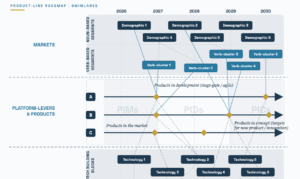
Figure — The product line stack on one roadmap: markets, platform-levers and products, and technologies plotted across generations.
Notice what the swimlanes force into a single frame. Markets, platform-levers and products, and technologies each get a lane, and every lane is plotted across the same generations. Read down a column and you see whether a generation is congruent — whether the segment, the platform, and the technology it depends on all arrive together. Read across a lane and you see one layer’s trajectory. The stack roadmap is the one artifact that makes both readings possible at once.
The Constructor
In Book 3, Winning the Race, this is the Constructor’s core motion: holding the product line’s congruency and assemblage as one act rather than two. The stack roadmap is where that motion becomes visible — and ConstructorOne™ is the platform built to keep the whole stack roadmapped, congruent, and current as the system learns.
The Two Jobs
The whole-stack roadmap is what brings coherence to the two things a product line team is always doing.
Coherent strategic moves
A product line strategy is a set of moves, not a wish list — and a single move usually touches several layers of the stack at once. The stack roadmap is where a move is composed across the lanes, so the segment, platform, product, and technology decisions reinforce one another instead of colliding. Without it, each function roadmaps its own layer and the company calls the sum a strategy.
Coherent ongoing management
Between the big moves, the line is steered day to day — reprioritized, resourced, adjusted. When that steering reads from the whole-stack roadmap, every adjustment is checked against the layers it touches. When it doesn’t, local fixes quietly break congruence, and the drift only surfaces generations later.
Responsiveness
None of this argues against responsiveness. A stack roadmap still has to be a live instrument — a GPS with a changing destination, not a fold-up map filed after the annual review. It absorbs insight and foresight continuously and adjusts the moves as the system learns.
But responsiveness on a partial roadmap only makes the drift faster: you react crisply in one lane while the others fall out of step. Responsiveness is what keeps the stack roadmap honest; whole-stack coverage is what keeps the responses coherent. And because the lanes run across generations, the plan stretches years ahead — multi-generational moves treated as one system trajectory, kept live by the loop.
The Shift
Strategic question for the boardroom: If we laid our segments, platforms, products, and technologies on one roadmap, would this year’s generation line up in a single column — or are we shipping layers that were never built to arrive together?
Takeaways
01Roadmap the stack, not the schedule — the whole system, in lanes, across generations; the launch calendar is an output of the plan, not the plan.
02Coherence lives in the columns — a generation works when its segment, platform, product, and technology arrive together, and the stack roadmap is where you can see whether they do.
03Respond on the whole stack — responsiveness keeps the roadmap honest, but only whole-stack coverage keeps the responses coherent.
ConstructorOne™ keeps your product line’s entire stack roadmapped, congruent, and current — the Constructor’s motion, made operational.