Core Concepts · MGPP
MGPP Turns “No” Into “Not Yet”
Multi-generational planning helps teams ship faster today — and, matured, it is how a product line plots its trajectory.
Features don’t get killed. They get sequenced.

Core Concepts · MGPP
Multi-generational planning helps teams ship faster today — and, matured, it is how a product line plots its trajectory.
Features don’t get killed. They get sequenced.
The Definition
MGPP stands for Multi-Generational Product Plan — the approach managers use to set which features a new product carries now and which wait for a later release. It defines a development project’s scope, and it banks every deferred feature as a candidate for the product’s next generation.
Some practitioners swap “product” for “project”; others say “planning” instead of “plan,” turning the acronym from a noun into a verb. The mechanics are the same.
The banked reserve is what separates MGPP from ordinary scope-setting. The team compiles the features it chose not to build, then weighs them for future generations instead of letting them force their way into the current project. That control delivers the two benefits every team wants — faster development and fewer cost overruns — both direct results of preventing scope creep.
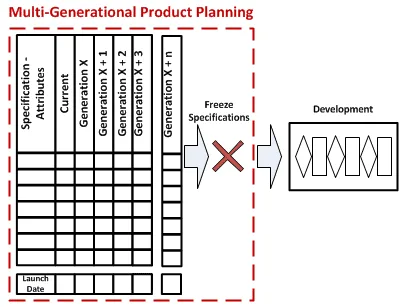
Figure — Features sequenced across generations in an MGPP.
Generation One
It is proper to think of a minimum viable product (MVP) as the first potential generation of a product. Possible, though, is not the same as wise: adding select features beyond the MVP often speeds market diffusion and fends off competitors. MGPP is the instrument for making that call deliberately rather than by accretion.
The approach also scales past individual products. Product line teams apply generational planning to platform-levers — the core designs and assets that enable leverage across multiple products. A new generation of a platform-lever moves every product built on it, which is why high-tech companies orchestrate their platform-levers with multi-generational plans.
Above the Backlog
Agile backlogs and multi-generational plans are not rivals; they operate at different altitudes. Backlogs streamline work on products already in the market — fixes, UX refinements, incremental features. In small and mid-sized companies where a single product is the product line, the backlog may be the only plan in sight.
Consider the Apple iPhone. Apple’s engineers surely work off backlogs for products already shipping. But advancements in chipsets, cameras, and screens are not backlog items — teams lay those out in multi-generational plans, above the backlog and ahead of it.
The System Move
Book 2 of the trilogy, Racing Change (2025), carries the idea to maturity: generations are not merely one product’s release sequence — they are the trajectory of the product line system. A generation extends existing parts rather than scrapping them, which makes it the natural unit of system change: teams can plan the interplay of the line’s parts and forces without starting over.
That maturity demands discipline. Managers must say “not yet” to features with strong political backing — and the move is never to kill a feature, but to place it in a future generation. Doing that credibly requires a clear product line strategy and a roadmap that responds as the system moves. Companies skilled in MGPP make smarter product line moves: greater customer benefit over time, improved free cash flow, and competitors kept at arm’s length.
The Shift
Strategic Question for the Boardroom
Which features in your current development projects actually belong to the next generation — and who has the authority to move them there?
Takeaways
MGPP sets what ships now and banks the rest, preventing scope creep and, with it, schedule slips and cost overruns.
A platform-lever’s next generation moves every product built on it; that is where MGPP earns its keep.
Per Racing Change, generations are how a product line system advances; plan them as system moves, not feature lists.
MGPP is where the trilogy’s argument starts moving — from The Profound Impact of Product Line Strategy (Book 1) to Racing Change (Book 2) to the Constructor (Book 3).