ConstructorOne

A guided tour of the system

The system of record (and judgment) for product-line strategy.

Cultivate the judgment your product line runs on.


A multi-agent system for innovation, development portfolios, and product lines — a relational and vector index of qualitative judgment beneath a projection engine that renders many views and analyses. Load once; project many.
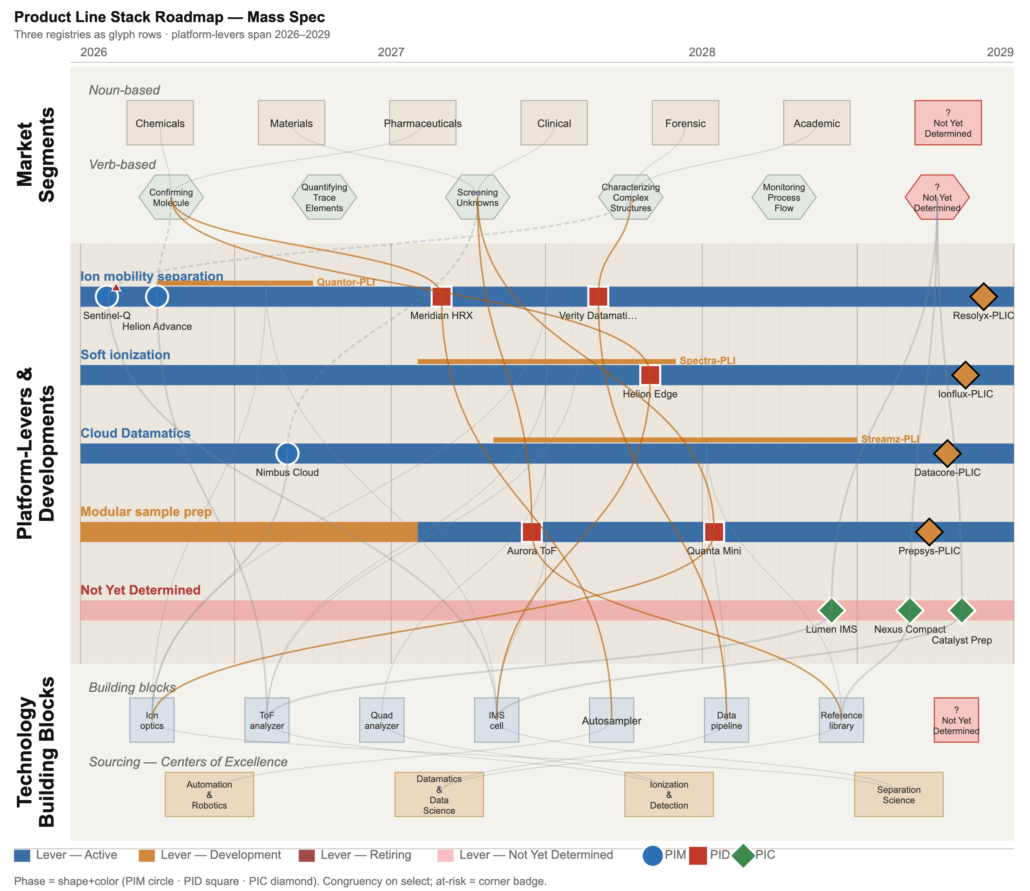
Live Multi-Product Stack Roadmap render

Three principles

The ideas that run through every screen

01

The analyst is the curator

You hold authoritative control of a permanently provisional interpretation. The system proposes; you authorise.

02

The chart is a probe, not the product

Views interrogate judgment — they are how you ask a question of the portfolio, never the deliverable.

03

Nothing auto-commits

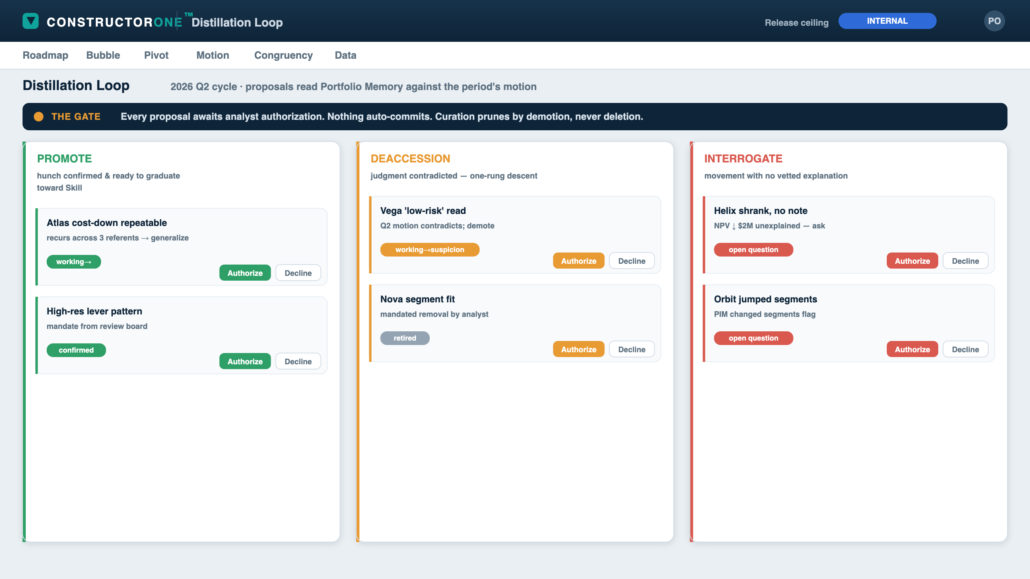
Every promotion, deaccession, and interrogation waits for a human decision. The record only moves when you move it.


What it is

Three components, one system

ConstructorOne is the union of three distinctly different things — not a product you license by the seat. Remove any one and the other two cannot do the work.

01 · Technology

An agentic technology stack

The multi-agent system itself — the ConstructorOne data layer and the PortView engine that index judgment and render many views. Powerful — and inert on its own.

02 · People

Your team’s human-in-the-loop cultivation

Your analysts do the curating: capturing notes, authorising claims each cycle, running the Distillation Loop. The judgment is cultivated by your people — nothing auto-commits.

03 · Method

The product line systems management framework

The Constructor method the whole thing is built on — congruency and assemblage held as one motion, the five roles, the Accelerating Learning Loop. The shape the technology and the judgment fill.

No shortcut

You can’t just buy seats from a software vendor.


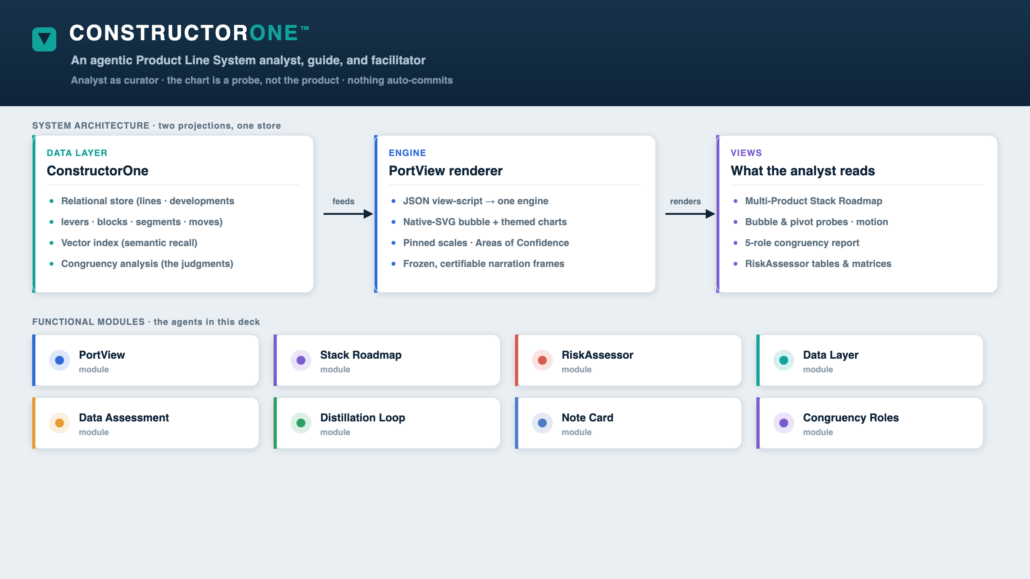
System architecture · two projections, one store

One store, one engine, many views

ConstructorOne is a relational and vector index of qualitative judgment beneath a projection engine that renders many views and analyses. The judgment persists, compounds, and loops; the quantitative working set becomes malleable and projected on demand.

Data layer

ConstructorOne™

  • Relational store — lines, developments, levers

  • Vector index — semantic recall

  • Congruency analysis — the judgments

Engine

PortView renderer

  • JSON view-script → one engine

  • Native-SVG bubble + themed charts

  • Pinned scales · Areas of Confidence

  • Frozen, certifiable frames

Views

What the analyst reads

  • Multi-Product Stack Roadmap

  • Bubble & pivot probes · motion

  • Five-role congruency report

  • RiskAssessor tables & matrices

The data layer feeds the engine; the engine renders what the analyst reads. Load once; project many — the judgment compounds and loops.

ConstructorOne system map — data layer, engine, views

The whole system: one store feeds one engine that renders many views.


The probes

Charts that interrogate your judgment

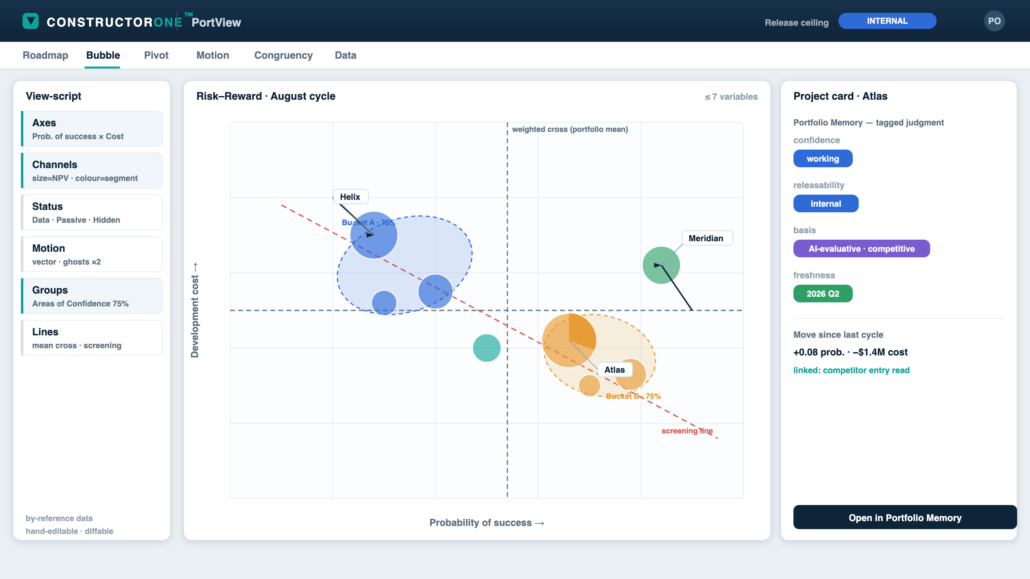
The signature view is the pivot bubble with Areas of Confidence — strategic groups drawn as covariance ellipses around the portfolio mean, so you can see whether two are genuinely distinct. Up to eleven dimensions live in a single view: position, size, segment ratio, colour, shape, labels, motion, lines.

PortView bubble probe with Areas of Confidence and portfolio-mean crosshair

Bubble view with Areas of Confidence and the portfolio-mean crosshair.

Principle

The chart is a probe, not the product.

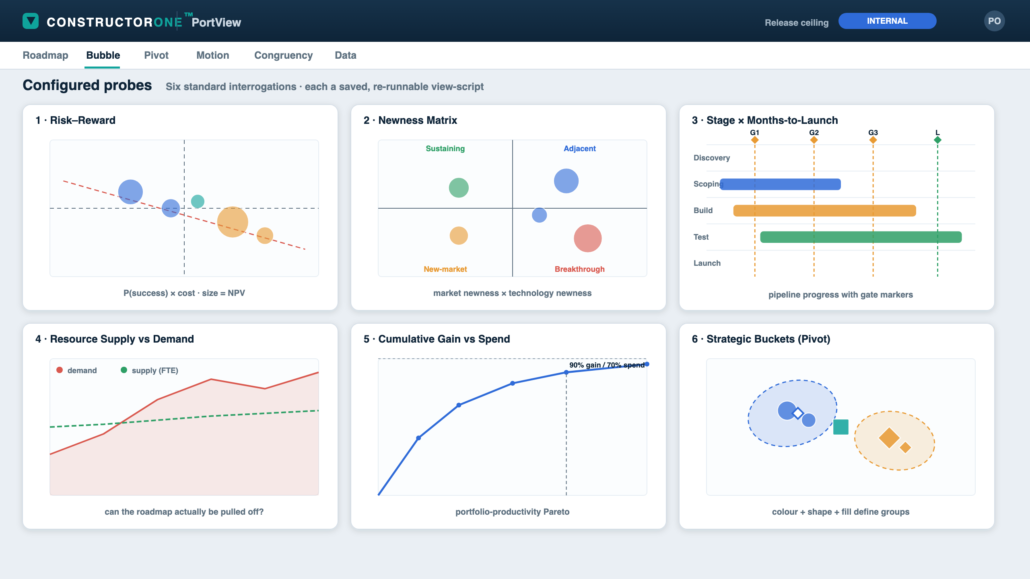
A gallery of six view archetypes

A gallery of view archetypes — each a different question asked of the same portfolio.


Motion · the stack

What changed since last cycle

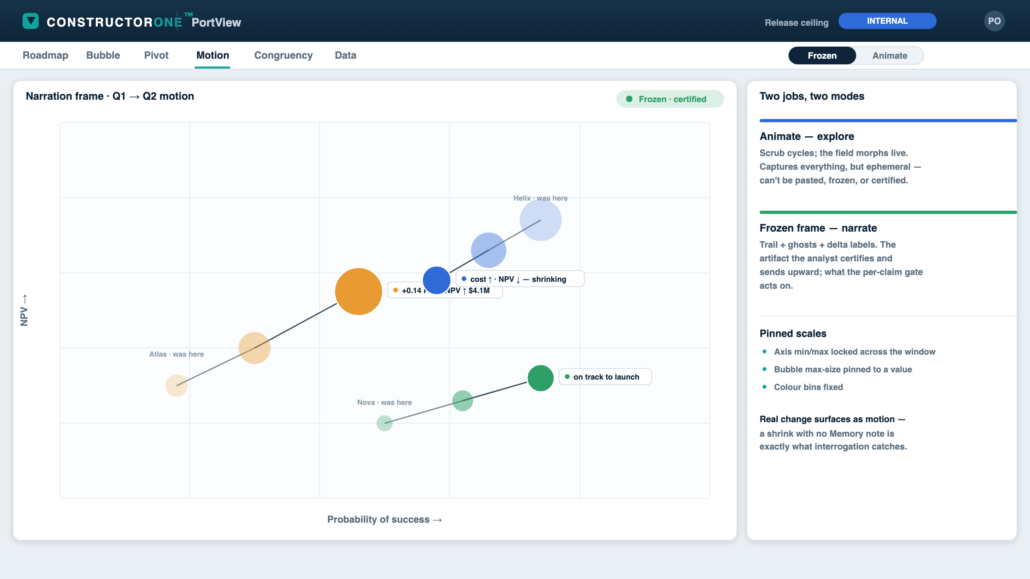
The projection vector animates real time-series. Bubbles move month to month, and movement without a vetted explanation is flagged rather than buried — the start of every interrogation.

Month-to-month motion across the portfolio

Month-to-month motion — a shrink with no note is what interrogation catches.

The Multi-Product Stack Roadmap

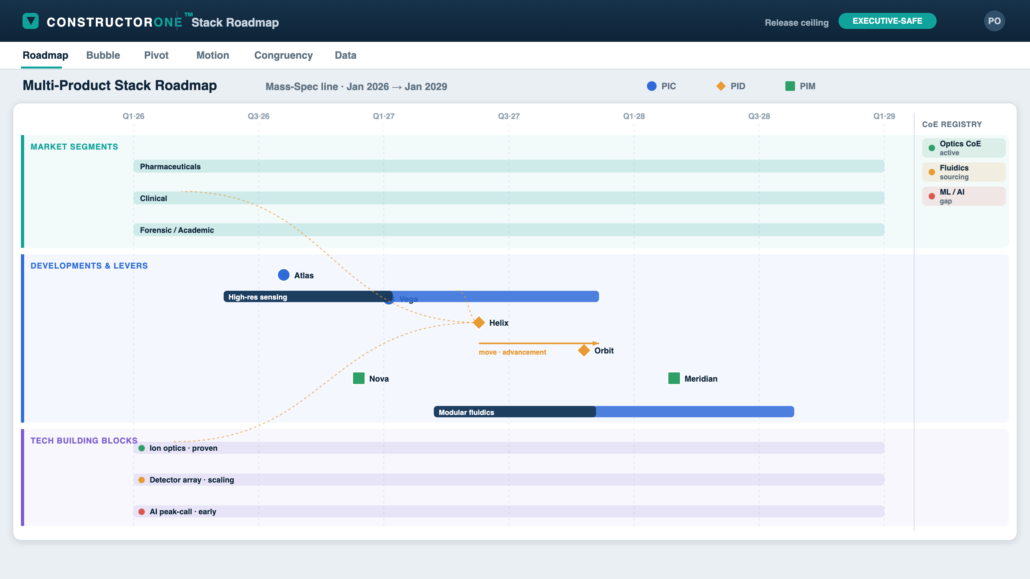
Above the portfolio sits the product-line stack: products, phases, levers, and the sourcing and centre-of-excellence registry that feed them — the structure ConstructorOne is built to manage, not merely chart.

The Multi-Product Stack Roadmap — registry-glyph lanes and layered relationships

Registry-glyph lanes; phase glyph marks the launch date; lever bars span their window.


Capture & curation

From a raw note to governed judgment

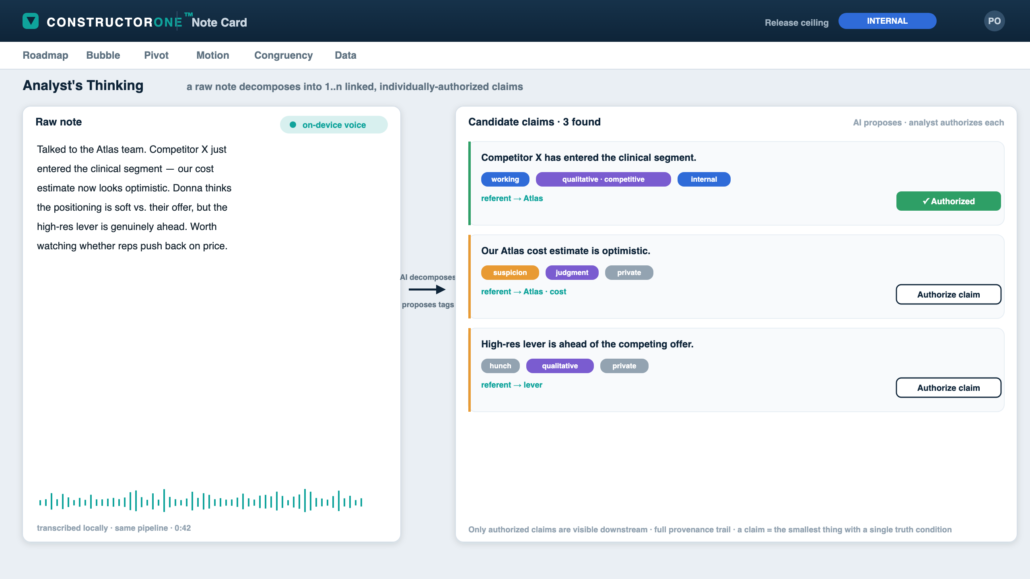
An analyst’s note is decomposed into linked candidate claims, each proposed with its tags; you authorise per claim. Then, each cycle, the Distillation Loop proposes promotions, deaccessions, and interrogations — and waits.

The note card — a raw thought becomes structured, tagged, authorised judgment

A raw thought becomes structured, tagged, authorised judgment.

The Distillation Loop — propose, authorise, compound

Propose → authorise → compound. Nothing auto-commits.


Risk & roles

Interpreted risk, congruent moves

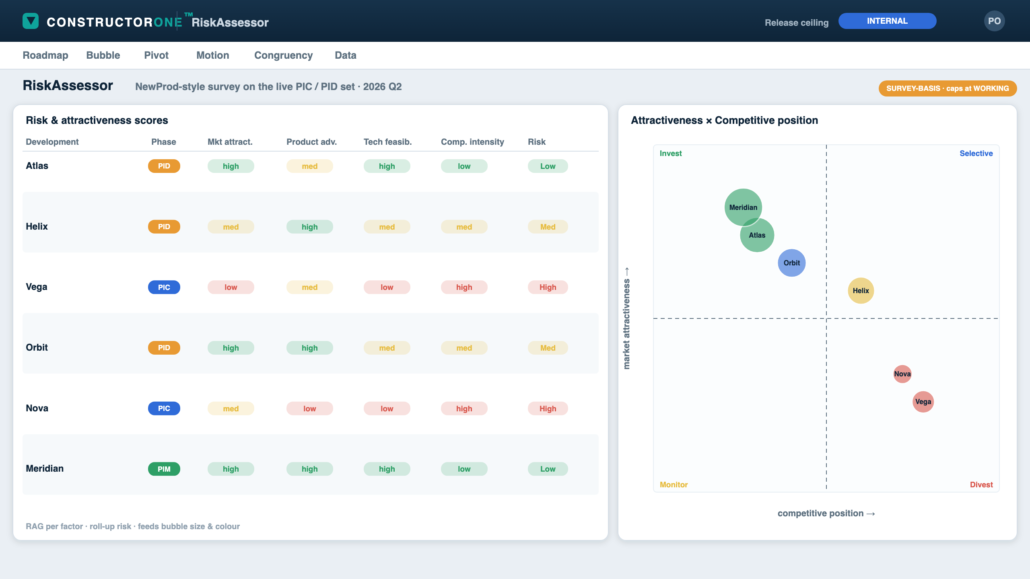
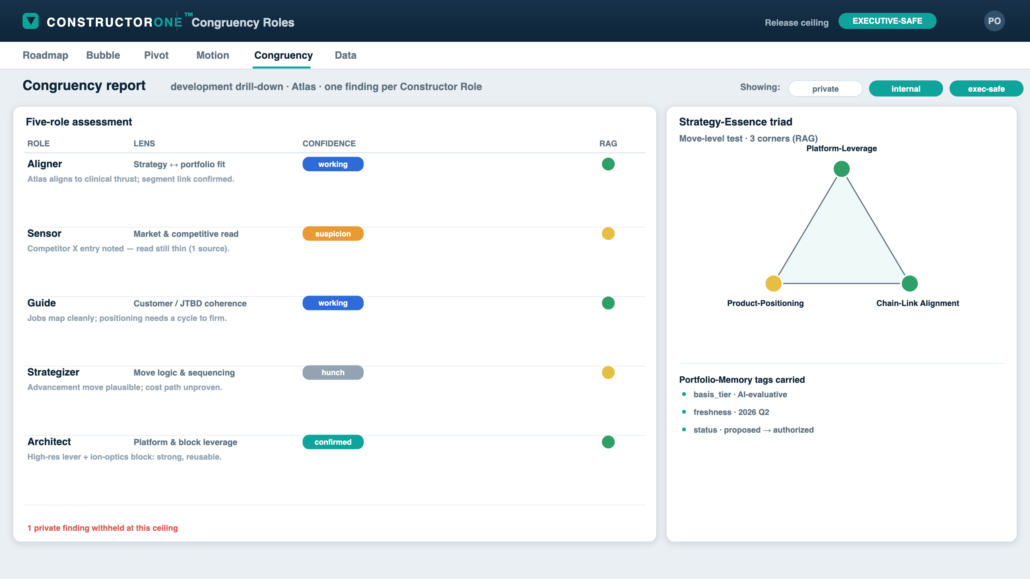
RiskAssessor scores developments against a calibrated, frozen core — never regenerated — and hangs the result on the development it belongs to. Congruency analysis reads the portfolio across the five Constructor roles the method is built on.

RiskAssessor — scored risk held beside the judgment the score cannot contain

Scored risk held beside the judgment the score can’t contain.

Congruency across the five Constructor roles

The release ceiling withholds findings above the selected level.


The foundation

Your data, your perimeter

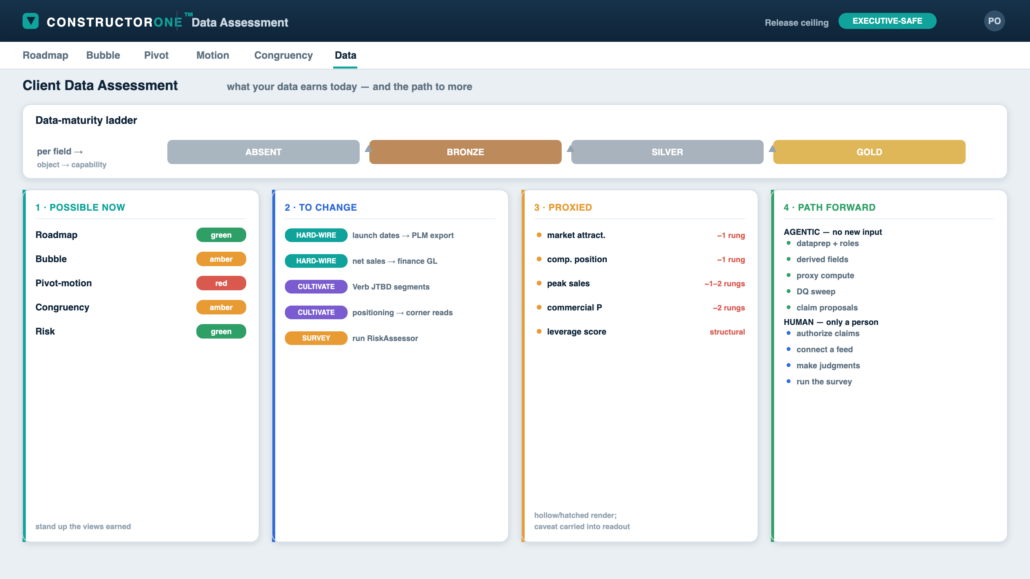
Everything runs on a customer-owned foundation. Adept ships the configured intelligence layer; your sources, your data, and your Portfolio Memory stay inside your walls. A data assessment maps what is possible now, what needs cultivating, and what can be proxied to get you there.

Adept is never in the data path. Ship the script, not the data.

A customer-owned foundation and the data assessment

Data assessment: possible-now, to-cultivate, proxied — and the path forward.

Next step

See it on your own structure

Work with us to create a “scrambled twin” (a mock-up of your new or existing product line). We’ll work with you to configure ConstructorOne™ to match that real shape—no security trigger.  This builds a focused rollout within 30 to 90 days. You curate as we go.

ConstructorOne™ Inquiry

ConstructorOne Inquiry