Flow & Outcome Velocity
Flow, Not Effort, Determines What Ships
Your teams aren’t shipping less because they’re working less. The constraint is product development flow — and no amount of effort unclogs a system.
Effort makes one lap heroic. Flow makes every lap faster than the last.
The Effort Trap
More Effort, Same Place
Product development looks simple from a distance: find a good idea, develop it, ship it. Every manager knows better. The hard part was never one product — it is shipping winner after winner, year after year, from the same product line.
The old school answer is effort. Push more projects into the funnel. Screen harder. Run the gates faster. Companies bolted Jobs-to-be-Done and design thinking onto the front end, Lean, Agile, and MVPs onto the middle, and sharper portfolio prioritization across the whole. The gains are real — the old approach runs faster than it did fifteen years ago.
Yet leadership keeps calling for home runs, because the funnel never produces enough of them. That call is the tell. Old school product development is a Red Queen’s Race: every competitor runs the same funnel, as fast as it can, to stay in the same place. When everyone holds the same time-to-market mantra, effort stops being an advantage.
Look instead at where work spends its time. Walk any product line and you find work sitting in queues — waiting for a decision, a data pull, a gate to open. Effort can’t fix that. Effort is what fills the queues.
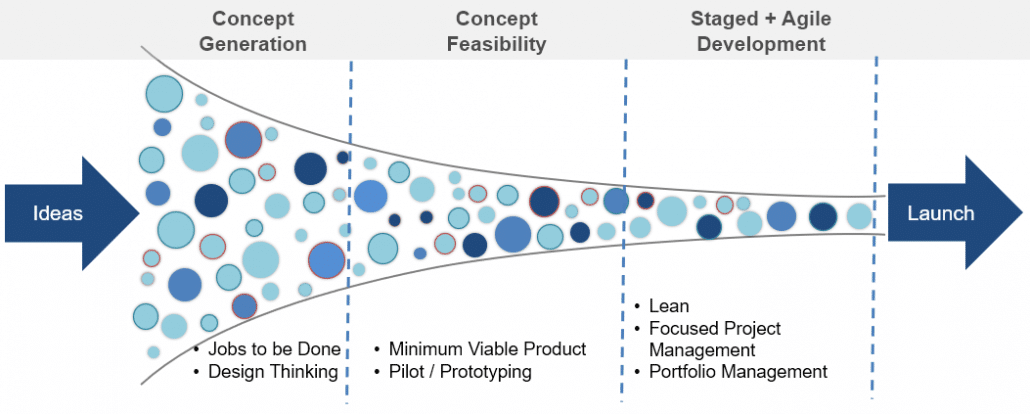
Figure — The old school process: create, screen, and speed individual products, one project at a time.
Flow Is a System Property
The Line Ships at the Rate It Flows
Effort is a property of teams. Flow is a property of the system — the product line as a whole.
Every development process braids three streams into one rope: a workflow, an information and data flow, and a decision flow. A product line ships at the rate its slowest stream allows, and no team-level heroics change that arithmetic.
This is why standard, company-wide processes underperform. No two product lines share the same characteristics — not even inside one company — so a single common process necessarily slows some lines down. The new school approach tailors the process to the line, and it changes the goal: from one project’s time-to-market to the line’s outcome velocity.
Outcome velocity is not raw speed. It is movement with direction — toward stronger competitive positions, better cash flow, and greater customer satisfaction. See What Is Outcome Velocity for the full measure. The shift only becomes visible once you stop managing products one at a time and start managing the multi-product line — the difference explained in Single- and Multi-Product Approaches.
Workflow
What gets built, in what order, by whom — from front-end targeting through life-cycle management.
Information & data flow
The evidence stream — market signals, test results, in-market performance — feeding every activity.
Decision flow
Who decides what, when — the stream where queues form first and flow dies quietly.

Figure — The new school process: front end to back end, designed to maximize a product line’s outcome velocity.
The Accelerating Learning Loop
One Lap at a Time
A product line that flows behaves like a race car on a circuit. Each pass — from market signal to shipped outcome and back to a sharper signal — is one lap of the Accelerating Learning Loop. Lap time is the flow measure that matters: how long the line takes to complete one full learning circuit.
Shorten the lap and learning compounds. Each generation ships sooner, and teaches the next generation more. Effort makes one lap heroic. Flow makes every lap faster than the last.
Screening Out Screening
The Funnel Is a Flow Killer
The old approach connects front end to back end with screening and selection. But every screen is a queue, and queues are where flow dies — along with the effort spent on projects that get screened out.
The new approach replaces screening with targeting. Innovations earn a deliberate place on the roadmap because they accelerate the line’s flow — and once targeted, they don’t need re-judging at every gate. Radical and disruptive innovations still happen. The ones that speed up the line get targeted onto it, up to and including a significant pivot. The ones that don’t get ring-fenced away from the line — they may be worth more to the business unit outside it, and the line’s process isn’t built to carry them.
Oversight changes with the process. Its job is not to pass verdicts on projects but to raise the line’s outcome velocity — finding where flow stalls and clearing it. That discipline is laid out in Product Line System Oversight; it is what Book 3, Winning the Race, formalizes in the Constructor, and what ConstructorOne™ carries into practice.
The Shift
From Pushing Projects to Improving Flow
- Stop rewarding effort. Start measuring flow — where work waits, not how hard teams push.
- Stop screening ideas through funnels. Start targeting innovations that accelerate the line’s flow.
- Stop forcing every line through one standard process. Start tailoring the process to each product line.
- Stop chasing one product’s time-to-market. Start shortening the line’s lap time.
Strategic Question for the Boardroom
In your flagship product line, where does work wait the longest — and who is accountable for shortening that queue?
Takeaways
Three Things to Hold Onto
Measure flow, not activity — track where work waits across all three streams: workflow, information flow, decision flow.
Shorten the lap — treat the Accelerating Learning Loop’s lap time as the line’s core speed metric, and let it compound.
Design the process around the line — one line, one tailored flow; ring-fence what the line isn’t built to carry.
Find Out Where Your Flow Stalls
Adept’s Flow Optimization service maps your line’s three streams, finds the queues, and shortens the lap.