Product Line Fundamentals
A Product Line Strategy Is a Coherent Set of Moves
Most “strategies” are lists of hopes. A real one commits the whole line to moves that reinforce each other.
Goals name the destination. Moves win the race.

Product Line Fundamentals
Most “strategies” are lists of hopes. A real one commits the whole line to moves that reinforce each other.
Goals name the destination. Moves win the race.
The Definition
A product line strategy is a coherent set of moves that advances an entire product line — not a list of goals, and not a stack of single-product plans. It commits the line to specific, mutually reinforcing actions: which products to create, which platforms to leverage, which customers to win, and in what order.
That word — coherent — is the test. A wish list names outcomes — grow share, enter the segment, refresh the portfolio — and leaves each team to chase them separately. A strategy makes the moves fit together, so decisions, actions, and investments reinforce the line instead of working against it.
Good strategies hold together across three interrelated concerns: product creation, organizational alignment, and in-market management. Neglect one and the other two unwind — a brilliant product plan stalls inside a misaligned organization and fails again in market. Our whitepaper on powerful product line strategies treats the challenges under each concern.
The Goal
The goal of every product line strategy is the same: improve customer satisfaction, increase income, and fend off competitors — across the full line, near term and long run.
A good strategy guides managers to match bundles of technologies with bundles of customer needs, and to do it repeatedly. A single product can win a round. Only the line, advanced deliberately, keeps winning.
Forming Strategy
Forming a product line strategy takes more than the single-product mindset most companies run on (trapped in the single-product mindset). Strategists must see the line as a system of parts and forces, weigh opportunities against threats, and foresee how change will play out. Two properties of the system do most of the strategic work:
Property One
Shared platforms turn one investment into many product outcomes; a neglected platform taxes every product built on it.
Property Two
The line performs like a linked chain: the weakest link caps total performance. Strengthen the links together, though, and the chain affords an advantage no competitor can copy one move at a time.
The moves range from new products and multi-generational advancements to pivots and complete transformations. Foresight about the line, its customers, and its competitors decides which belong in the set.
Execution
A strategy without execution is a document. So a good product line strategy also sets up its own carry-out — a mechanism that helps teams respond to change, whether a major disruption or a minor hiccup. That mechanism is Responsive Roadmapping: a continuous process that keeps the moves current as conditions shift instead of archiving last year’s intentions.
The Shift
Strategic Question for the Boardroom
If we deleted every goal from our product line strategy and kept only the committed moves, would what remains still cohere — or were we holding a wish list?
Takeaways
Define strategy as moves A coherent set of mutually reinforcing moves, not a list of desired outcomes.
Work all three concerns Product creation, organizational alignment, and in-market management rise or fall together.
Build in the carry-out Tie the strategy to Responsive Roadmapping so execution adjusts as conditions change.
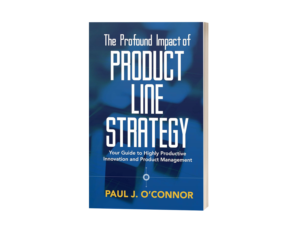
Book 1 of the Trilogy
The full case is Book 1 of the trilogy: The Profound Impact of Product Line Strategies (2018). Start there, then follow the trilogy through Racing Change and Winning the Race.