Oversight Exists to Raise Outcome Velocity, Not to Pass Verdicts
Most governance slows a product line down so leaders can feel in control. Oversight done right is the mechanism that makes the whole line faster.
Verdicts feel like control. Outcome velocity is control.
Three Flows
Every Product Line Moves in One of Three Flows
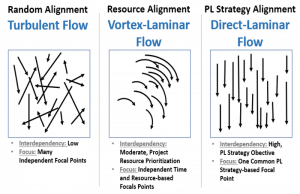
Watch how work moves through a product line and you will see one of three flows. The first is turbulent — many projects running independently, decisions taken in disconnected forums, energy spent everywhere and progress made nowhere in particular. The second is a vortex-induced flow. It is much faster, and companies create it deliberately: sharp project management, portfolio prioritization, and a time-to-market mantra repeated in every meeting.
The vortex works — that is why nearly every serious company built one. But a vortex has a flaw: its direction is not chosen. It pushes work through the constraint faster than turbulence ever could, yet it bleeds energy on the way, and it points wherever the swirl happens to point. Results are good. Not stellar.
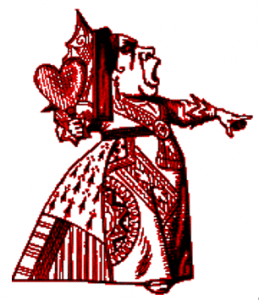
There is a deeper problem. Time-to-market has been the dominant mantra since the 1980s, so every competitor now runs the same race with the same metrics, the same mantras, the same techniques. That race is the Red Queen’s, exactly as Lewis Carroll had her explain it to Alice:
“Now, here, you see, it takes all the running you can do, to keep in the same place. If you want to get somewhere else, you must run at least twice as fast as that!”
— Lewis Carroll, Through the Looking-Glass
The third flow is different in kind, not merely in degree: a direct laminar flow, aimed straight at the line’s objectives and key results. It does not come from preaching speed harder. It comes from oversight designed to create it.
Figure — The three flows: turbulent, vortex-induced, and direct laminar.
The Straw
Direct Flow Needs a Straw — and the Straw Is Oversight
A laminar flow does not happen in an open cup; it needs a straw. For a product line, the straw is smart oversight of the line laid out as a system of parts and forces — products, platforms, channels, and the forces that pull them toward customers or away, all interacting as one whole. We named that viewpoint PLaaS™ — Product Line as a System — and it is developed in full in product lines as systems.
Systems thinking supplies the principle that makes such oversight practical: because the parts interact, influence over the whole does not require control over every part. A narrow focus can steer the entire system. Great product line performance does not demand that every product carry its own layer of management — it demands oversight concentrated on the few focal points with leverage over everything else.
We know where that leverage usually sits. As a set, we call it the Strategy-Essence:
Platform-Levers — the shared foundations that multiply every move built on them;
Attribute Positioning — the match between product attributes and customer needs that pulls products to market; and
Chain-Link Alignment and Synergy — the tight unison across the line that competitors cannot copy one piece at a time.
Build strength into all three, orchestrate their interactions as one motion, and you set the stage for performance the vortex cannot reach.
Constructor-Shaped Governance
Verdicts Judge the Past. Decision Flow Feeds the Future.
Here is where most companies get oversight wrong. Traditional governance is a verdict machine: work travels to a review, the review rules pass or kill, and the line waits for the ruling. A verdict looks like control, but it adds no outcome velocity — it only spends it. And a verdict ends a conversation precisely where a product line needs the conversation to continue.
Oversight shaped like the Constructor works differently. The Constructor holds congruency and assemblage as one motion — judging whether a move fits the strategy and building the line’s next state are the same act, not separate meetings. Governance in that shape stops being a court and becomes a decision flow: a steady movement of choices, each made at the moment the system needs it, each feeding the next.
And decisions compound only if the line remembers them. That is portfolio memory — the rationale, insights, and foresight behind every choice, retained and refreshed so no decision starts from zero and no hard-won understanding evaporates when a meeting ends.
The Shift
From Passing Verdicts to Raising Outcome Velocity
Stop convening reviews to pass verdicts. Start designing oversight whose output is outcome velocity.
Stop preaching time-to-market harder. Start aiming flow directly at the line’s objectives and key results.
Stop managing every product separately. Start steering the few focal points that move the whole system.
Stop letting decisions evaporate when the meeting ends. Start compounding portfolio memory every future decision can draw on.
Strategic Question for the Boardroom
If your product line governance disappeared tomorrow, would the line move faster or slower — and what does that answer say about what your governance is for?
Takeaways
Three Things to Hold Onto
1
Direct the flow — turbulent and vortex-induced flows are the default; a direct laminar flow aimed at the line’s OKRs is designed, and oversight is what designs it.
2
Govern the system, not the products — a narrow focus on the Strategy-Essence gives more control than a verdict on every project ever will.
3
Make decisions compound — Constructor-shaped governance runs on decision flow and portfolio memory, so every choice raises the value of the next one.
See What Oversight Built for Outcome Velocity Looks Like
Constructor-shaped oversight is not a slide — it is how ConstructorOne™ runs a product line day to day. Talk with us about what it would look like on your line.
 “Now, here, you see, it takes all the running you can do, to keep in the same place. If you want to get somewhere else, you must run at least twice as fast as that!”