
Fighting Evil Complexity Costs
Smart Product Line Strategies & Roadmaps
Accounting can be as thrilling as getting teeth pulled. Cost accounting, however, is a skill product developers must get their arms around. This is the black art of calculating how much products cost to develop, make and sell. I call it a black art not because of the easily understood direct, variable cost of a product. Rather it is a black art because a wizard must allocate mysterious organizational overhead to a product line to discover the true profitability.
Long ago in a place far away, let’s call it the industrial revolution, business managers developed skills and approaches to calculate contribution margins. They reasoned it to be revenue less direct cost of goods sold. This lead to breakeven points by dividing up-front investments divided by contributions. The early twentieth century brought us the discounted cash flow (think NPV). By mid-century, the whiz kids at Ford coupled cash flow to the start of operational excellence. But a funny thing happened as we came to the end of the 1900’s. Organizations grew much more sophisticated and added complexity to almost everything that they do. Unfortunately, the increase in complexity has been many-fold. It is this rapid ramp up of complexity that got things very screwed up for the cost accountants.
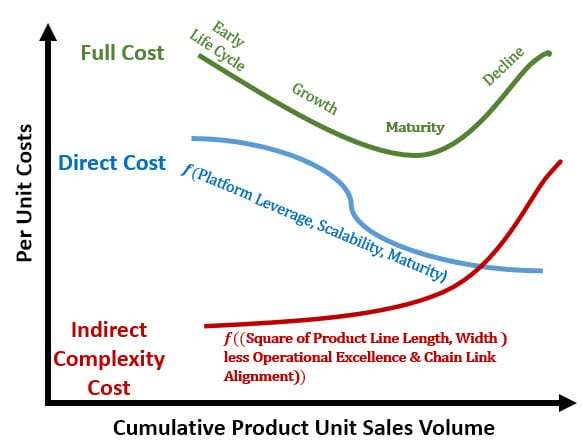
The simple linear method used to allocate costs, as taught to most cost accountants, disconnects from reality. Complexity costs do not track linearly with product volumes or revenue. Instead, complexity costs track more along a curved line that is the square of complexity[i]. Double complexity and you’ll quadruple the overhead costs needing allocation. Cut complexity in half and you reduce the associated cost of complexity by three quarters. Mind you, this is not for all product sold. Rather it is just for those products and that add to complexity.
Economies of scale is a powerful notion in product strategy. The greater the volume the lower the cost of each unit sold. The Product Line Cost Structure chart below show this in the downward concave curve for variable costs. Allocated fixed cost appear as a downward step function versus volume sold. In the old model of assigning costs, only these two factors matter. The more volume, the lower the cost. Unfortunately, the reality is the upward square of complexity curve will at some point add more cost than value gained. If left unchecked, growth in complexity will wipe out all profitability.
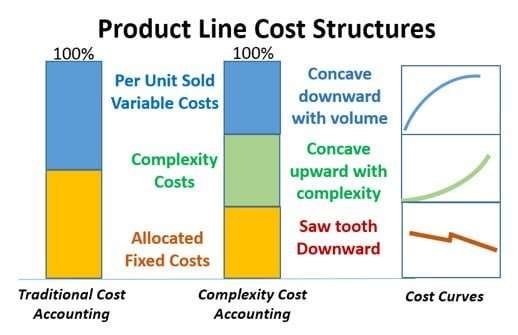
Figure 1. Cost breakdown for new products.
This is where things get interesting for the product line strategist. First, recognize that all the players in any market must deal with issues of variable cost, fixed costs and complexity costs. However, everyone has their own unique structure, strategy and roadmap. Also, consider that nothing is static. Time and deliberate change can work to each player’s advantage or disadvantage, depending what they carry out or what they avoid.
A stellar product line strategy will win the cost structure game while also delivering greater customer satisfaction. If strategy execution falls short on either cost or customer satisfaction, the product line will likely face some troubles. If it falls short on both, the product line will not be around much longer.
The key to good strategy is to understand how things may play out . Strategists need foresee how complexity and added value will play out . Actively dampening and removing complexity, especially non-value-added complexity, goes a long way in avoiding the evil, profit-sucking upward cost curve.
This is why decisions and actions related to the Product Line’s Strategy and Roadmap matter. Strategist can deliberately simplify the line by using these strategy components. The Essence of the Strategy includes three parts:
- Attribute Positioning: This part addresses variety, price points, performance features, and customer-perceived synergies within the product line.
- High variety may increase complexity with inventory and working capital
- Poor synergy between products makes marketing and selling more difficult and complex
- Platform-lever(s) and Organizational Fulcrum(s): This part seeks leverage from at least one common core to the product line.
- Lack of platform leverage makes developing each product within the line more complex, expensive, and time-consuming;
- Poor or poorly carried out organizational fulcrums will increase the complexity of execution
- Chain-Link Alignment: This part seeks gain from non-product specific roles such as sales, manufacturing, human resources, finance and brand management.
- Friction between chain links caused by each chain link following its own strategy without deliberate alignment will increase complexity.
The roadmap reveals moves, projects and initiatives related to the product line. The number of items on the roadmap reflects complexity of the product line. Roadmaps include items such as:
- Platform-levers (existing, under development, under concept formation)
- Products-in-development, front end innovation projects, and incremental improvements to existing products;
- Market Segments (existing and new to the product line)
- Technology building blocks that add value to platform (existing, under development, in formation, in search of)
The approach that strategists should take to battle the upward cost curve of complexity is straightforward. The idea is to use roadmapping to rationalize the number of items in play or added to the product line. This will reduce existing complexity and mitigate future complexity creep. Plus, strategists should seek brilliance in how the strategy essence parts come together. The idea is to gain greater value from the product line while dampening overall complexity. This entails smartly creating and blending the positioning option, platforms and fulcrums, and chain-link synergy.
Figure 2. Complexity can increase in response to maturity.
So let’s get down into the basic facts of cost accounting and product line complexity. The gains from reigning in complexity are real. However, depending upon product line and its organization, an exact approach may be difficult to figure out. Creating and then carrying out an approach to do so is what matters. Such an approach is a “strategy lens” on the product line.
From a high-level view, the complexity value-cost lens must breakdown costs into three components: variable, fixed, and complexity. To create this lens, start with just direct variable costs. Lay out per unit variable cost as volume increases. Remember that not all units are equal. Some products may have variable costs different from other products. Plot this out. It should reveal a downward slope of variable cost per unit.
Next, add in all fixed costs, without consideration of complexity. This may take investigation. Fixed costs add up or are subtracted in chunks. Figure 1 suggests this is a saw tooth function downward. Using data available for variable and fixed contributions, plot out the normalized per unit cost against unit volume of the product line.
Next, the challenge is to add in complexity costs. This demands a few estimates and judgments. First, is the measure of complexity in the product line. This is where the product line roadmap becomes handy. The roadmap helps lay out the key objects in the strategy. The more objects, the more complicated the strategy.
Learn the ins and outs of Product Line Strategies
Learning product line strategy is important and valuable. Adept offers a two-day interactive workshop on the topic. If complexity costs are important to your organization, consider joining the workshop to learn how to spot, analyze, and mitigate it. You may find more information on the workshop at:
Product Line Strategy Workshop
Learn the Framework
Learning and applying the framework is important. Adept offers several venues to help. Our most impactful is a two-day interactive workshop. If product line strategy effectiveness is important to your organization, consider joining the workshop to learn the framework and how to embed it in your organization. You may find more information on the workshop here.